
The 100 Rizing Stars of 2025

Jan 21, 2026
Private Limited Company vs. Limited Liability Partnerships

Celebrating the Top 100 Startups from the Rize Community!

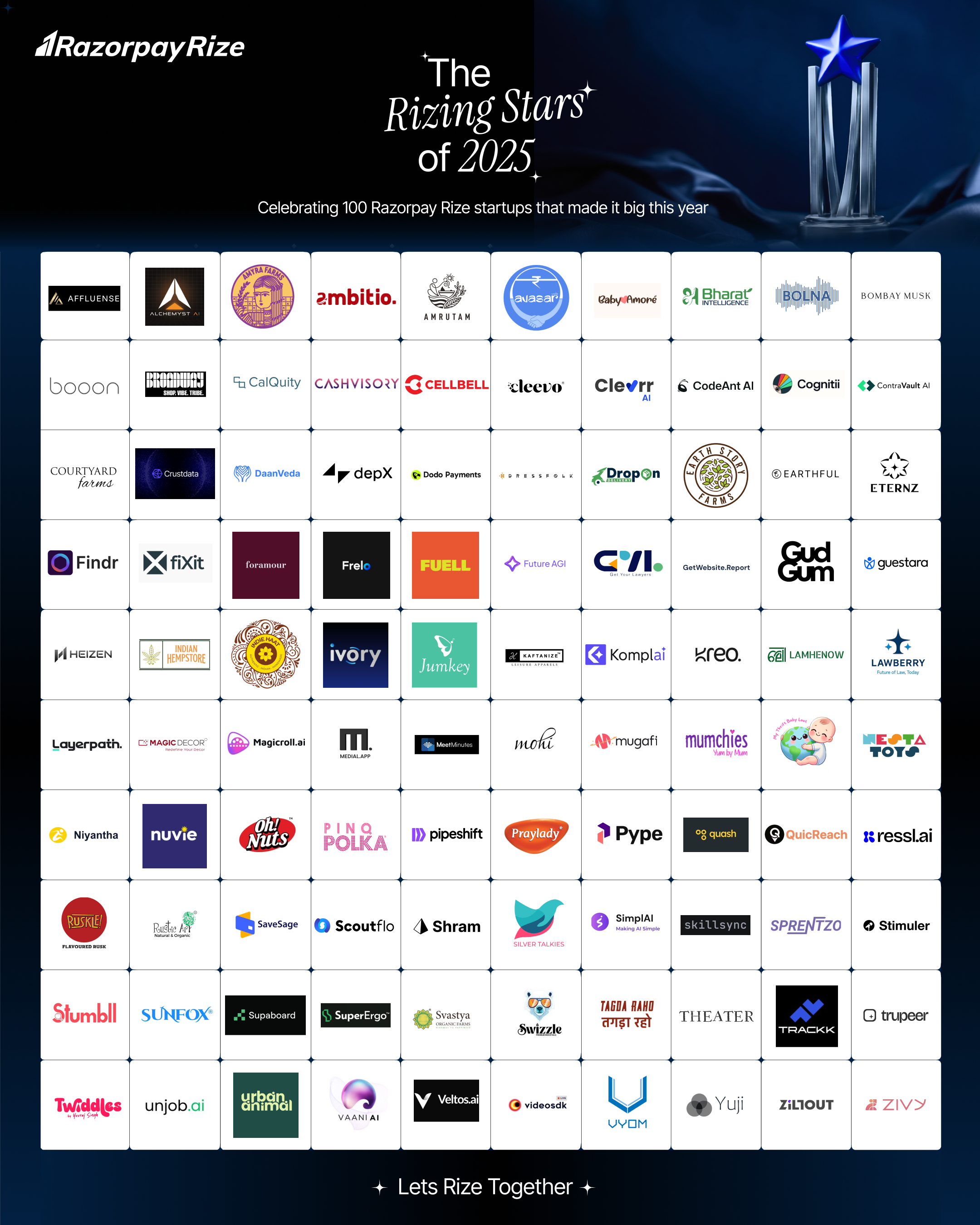
We’re proud to present Rizing Stars 2025- our annual curation of the Top 100 startups shaping the future from within the Rize ecosystem.

This list celebrates the many ways founders are winning today- from funding milestones and Y Combinator selections, to Product Hunt launches, national TV appearances, industry awards, and more. Together, these startups reflect the breadth and depth of the Rize community, spanning fintech, SaaS, AI, consumer, climate, D2C, exporters, and more- united by conviction, momentum, and the ambition to build enduring companies.
The Rizing Stars of 2025

Table of Contents

The 100 Rizing Stars of 2025

Below are the 100 startups recognised as Rizing Stars 2025.

  • Affluense AI: An AI-powered platform that helps businesses discover and engage HNI & UHNI individuals with real-time, 360° profiles.
  • Alchemyst AI: Alchemyst AI is a context engine that provides AI applications with persistent memory, business data, and operational context so agents remain accurate, reliable, and production-ready. It is a standalone context layer that can be integrated into the stack through our APIs, SDKs and MCPs.
  • Amyra Farms: Amyra Farms is a Farm-to-Table company dedicated to growing and processing high-quality Coffee, Pepper, and Vanilla.
  • Ambitio: AI Copilot for Higher Education Abroad. Ambitio's AI platform assists in the complete study abroad journey, right from program selection to crafting your application and getting those dream admits.
  • Amrutam: Amrutam is a global Ayurvedic lifestyle brand on a mission to make Ayurveda accessible, authentic, and contemporary. Rooted in ancient wisdom and backed by modern science, they create holistic solutions for health, wellness, and beauty.
  • Avasar: Avasar is a micro-task platform that helps individuals in Tier 2/3/4 India earn income through simple, smartphone-based tasks like referrals, surveys, promotions & gigs.

  • BabyAmore: Baby Amore is a eCommerce website catering to every baby’s need. Their focus is to sell organic, eco friendly and premium baby products.
  • Bharat Intelligence: Bharat Intelligence is building India’s operating system for agricultural labour. They organise farm labour into trained, verified crews and deliver agricultural work as a managed service
  • Bolna: Bolna is a Voice AI Platform purpose-built for India’s scale, linguistic complexity, and cost sensitivity. They enable enterprises to go live with thousands of concurrent calls in days.
  • Bombay Musk: Bombay Musk is a luxury car perfume brand designed to elevate every drive with premium fragrances that embody sophistication and style.
  • Booon: Booon.in is India’s First fashion-forward platform delivering all the style needs in just 2 hours.
  • Broadway: With a vision of a shared economy in retail, Broadway provides a platform of 20,000+ sq ft canvases in prime malls for brands to paint their stories, captivate consumers through unique narratives and in-person engagements to establish trust and induce trials.

  • Calquity: CalQuity is building the future of equity research with an AI-powered platform that unifies filings, earnings calls, and news into a single intelligent interface.
  • Cashvisory: Cashvisory empowers first-time investors with expert-backed strategies and simplified tools, making wealth-building accessible to everyone.
  • CellBell: Cellbell primarily offers ergonomic office and gaming chairs online in India, along with related services like delivery, installation, and warranty support. They focus on providing comfortable and durable seating solutions at affordable prices.
  • Cleevo: With an unique powder-to-liquid technology, Cleevo aim to inspire a new generation of clean and simplify life.
  • Clevrr AI: Clevrr AI is a SaaS platform helping D2C/Consumer brands unify data from 50+ omnichannels into a single source of truth with an AI Agent on top of it.
  • CodeAnt: CodeAnt AI is the Code Health platform built for the AI era. They bring AI Code Review, Code Security, Code Quality, and Engineering Metrics into one unified platform.
  • Cogniti: Cognitii is a mobile first, AI powered ecosystem that helps schools detect learning needs early, personalise support for children with developmental and learning disabilities, and reduce educator workload.
  • Courtyard Farms: Courtyard Farms delivers 100% natural, fresh goat milk and dairy products directly from farm to doorstep, promoting healthier, preservative-free nutrition.
  • Crustdata: Crustdata is an AI-powered people and Company Search tool for sales, recruitment and investment with the freshest, most trusted data.

  • DaanVeda: DaanVeda is an AI-driven fundraising intelligence platform, empowering nonprofits to raise more funds efficiently. They offer a unified solution addressing key challenges in the fundraising landscape.
  • depX: depX is an AI Ecosystem for DevOps. Deploy, manage and monitor your entire cloud infrastructure with as few as two lines in English. depX offers a no-code, ChatGPT-like interface for DevOps and Cloud engineers.
  • Dodo Payments: Dodo Payments is a global Payments & Billing platform helping SaaS and AI-native businesses scale across 150+ countries.
  • Dressfolk: Dressfolk is on a mission to modernise timeless Indian weaves. They design and co-produce all garments with the artisan community from scratch.
  • Dropon Delivery: Dropon is an emerging startup in eco-friendly, tech-driven logistics, transforming on-demand delivery with AI-powered optimisation and green mobility.

  • Earth Story Farm: Earth Story Farm grows, make and source chemical-free products, preserving the goodness, freshness and locking their complexity of flavours.
  • Earthful: Shark Tank-approved Earthful was founded in 2020 by sisters and IIT Kharagpur alumnae Veda Gogineni and Sai Sudha G. They are on a mission to tackle undernutrition in India with clean, plant-based nutrition. Earthful offers 100% natural supplements- free from additives and backed by science.
  • Eternz: Eternz is a new-age jewellery and watch marketplace redefining how India discovers and experiences fine craftsmanship. With a deep love for design and detail, they bring together curated collections from India’s finest brands as well as exquisite international names.

  • Findr: Findr is an AI workspace that lets you instantly capture, delightfully organise, and chat with anything you've saved. This includes PDFs, videos, articles, links, emails, information inside apps, and more.
  • Fixit: Fixit is an AI-powered junior broker, an agentic sales assistant built for real estate sales who don’t have time to chase dead leads. It qualifies, nurtures, and follows up with every prospect.
  • Foramour: Foramour offers 18k gold plated jewellery brand that makes gifting effortless yet thoughtful.
  • Frelo: Frelo is an AI based platform for Indian startups seeking top-tier freelancers in Tech, Design and Content. They simplify the hiring process by streamlining the posting of requirements, freelancer selection, and payments.
  • Fuell: Fuell provides clean, bite-sized snacks, made from just dry fruits and nuts, with no added sugar or preservatives.
  • Future AGI: Designed for the modern era of Generative AI, Future AGI provides intuitive tools for fine-tuning prompts, LLM experimentation, evaluating models, annotating data or optimising performance, making complex AI workflows seamless and efficient.

  • Get Your Lawyers: Get Your Lawyers is a cutting-edge AI-powered SaaS platform designed for legal professionals, providing an all-in-one solution for end-to-end legal practice management.
  • GetWebsite.Report: A complete webpage audit tool to get personalised insights & AI-powered actionable fixes to improve design, usability, user experience & SEO on all devices to maximise conversion.
  • Gud Gum: Gud Gum is India's first plastic-free, all-natural & biodegradable chewing gum. Free from all artificial sweeteners, flavours & colours.
  • Guestara: Guestara is an AI Guest Management Platform designed to meet the needs of hospitality professionals worldwide.

  • Heizen: Heizen is building an ecosystem to build, deploy, and manage fully functional enterprise-grade AI Apps.

  • Indian Hemp Store: Indian Hemp Store is India's 1st Hybrid Hemp Marketplace.
  • Indiehaat: IndieHaat was started with a vision and direction to surface the beautiful hidden treasures of the magnificent world of handmade products.
  • Ivory: Ivory transforms the ageing experience by nurturing sharper minds and healthier living. They help in the early detection of neurodegenerative risks and provide personalised brain health solutions.

  • Jumkey: Jumkey introduces safer materials for the environment which are skin friendly, sustainable and meets International quality standards.

  • Kaftanize: Kaftanize is a popular clothing line with fashion-conscious ladies.Their clothing is crafted from premium fabrics with an emphasis on simple shapes and understated elegance.
  • Komplai: Komplai is an AI-powered solution that helps businesses manage their financial accounts and all regulatory filings.
  • Kreo: Kreo is a consumer electronics brand they enable content creators & gamers to elevate their passion beyond limits by providing them with premium products.

  • Lamhenow: Lamhenow is a sustainable gifting solutions company. They are creating products which will be long-term and timeless, keeping in mind the creativity.
  • Lawberry: Lawberry is a pioneering legal tech platform that combines AI intelligence with legal expertise. The primary features include AI-powered research, drafting, and summarisation tools, alongside robust case management features.
  • Layerpath: Layerpath's Path AI turns the website into a live product conversation. It answers questions, shows the right demo, and books meetings- so your team only talks to ready buyers.

  • Magic Decor: Magic Decor has a curator-driven method to customise wall murals and wall decorative items. Their core is driven by on-demand production and an enhanced manufacturing process driven by automation.
  • Magicroll: Magicroll.ai is an AI-powered video editing and creation platform that helps creators, brands, and businesses turn raw footage into polished, engaging videos in minutes.
  • Medial: Medial is the next-gen professional social media platform from India to the world.
  • MeetMinutes: With support for 30+ languages, including unique mixed languages, seamless integration with popular tools and CRMs, and a focus on capturing key insights and action items, MeetMinutes is an indispensable partner in achieving meeting excellence.
  • Mohi Fashion: Mohi Fashion is a curated multi-designer Indian ethnic wear marketplace sourcing from authentic sellers across India for special occasions, weddings.
  • Mugafi: Mugafi is a next-gen entertainment powerhouse combining Tech, AI, storytelling, and cultural depth to build original cinematic universes.
  • Mumchies: Mumchies offers wholesome traditional-meets-contemporary sweets, savouries & millet delights made with premium ingredients for healthy, delicious snacking.
  • My Thrift Baby Loot: My Thrift Baby Loot is an easy platform where Parents can declutter by selling the things that their babies have outgrown to other parents who can buy the essentials at a lot lower than market price, save their money and save the planet in the process too.

  • Nesta Toys: Nesta Toys offer simple & open-ended play where the child drives the playtime. The toys are designed to encourage kids to see new possibilities and spur their imaginations.
  • Niyantha: Niyantha is building the Vehicle Cloud and AI Platform for transportation, agriculture and seafood supply chains.
  • Nuvie: Nuvie is redefining healthy eating by creating food products that make wellness both enjoyable and accessible.

  • OhNuts: Oh! Nuts is a health-focused snack brand from India that’s reinventing how people think about munching- with chips made from real nuts that are crispy and flavourful

  • Pinq Polka: Pinq Polka provides high-quality products that address both women’s hygiene and fashion needs, helping them navigate each day with assurance and poise.
  • Pipeshift: Pipeshift is a fast, scalable, and production-ready orchestration platform to build with open-source AI- embeddings, vector databases, LLMs, vision models, and audio models- in any cloud or on-prem.
  • Praylady: Praylady has gained a niche through its state-of-the-art manufacturing technology, and for producing unparalleled cookware that rings a bell in every kitchen in town.
  • Pype AI: Pype AI delivers ready-to-deploy, speciality-trained voice agents for healthcare. They automate critical patient interactions- scheduling, follow-ups, treatment prep, and 24/7 support- helping hospitals go live in days.

  • Quash: Quash is a SaaS tool that helps companies streamline and speed up their software testing process. It helps testers report bugs quickly, and assists developers in resolving them.
  • QuicReach: QuicReach offers pre-scheduled shared cabs tailored for solo travellers. Their solution combines the affordability of public transport with the comfort of personal cabs, providing a unique and much-needed alternative for long-distance travel.

  • Ressl AI: Ressl AI is building the future of Salesforce implementation and operations, powered by AI agents. They partner with fast-growing companies to scale their Salesforce orgs without scaling headcount.
  • Ruskle: Ruskle is a modern Indian snack brand reinventing the traditional rusk with baked, flavour-rich, no-maida varieties like Butter Garlic, Blueberry, Green Chutney, and more for guilt-free tea-time snacking.
  • Rustic Art: Rustic Art is an organic and natural personal and home care brand that believes in sustainable manufacturing and a sustainable lifestyle. All the products are cruelty-free & vegan.

  • SaveSage: SaveSage simplifies a user's credit card journey by helping them choose the best card based on their spending habits.
  • Scoutflo: Scoutflo is on a mission to make Infrastructure management self-serve for developers.
  • Shram: An AI-powered to-do list that automatically captures tasks from the screen and voice, so work manages itself.
  • Silver talkies: Silver Talkies is a pioneering social enterprise on a mission since 2014 to make healthy and active ageing a desirable and viable goal for older adults.
  • SimplAI: SimplAI is a full-stack Agentic AI Operating System built for enterprises that need to move beyond isolated LLM experiments and deploy AI that actually runs production workflows.
  • Skillsync: Skillsync is a search platform to find engineers & scientists based on their code / research. They are on a mission to organise the world's talent.
  • Sprentzo: Sprentzo is an innovative sports platform with a mission to make sports more accessible, affordable, and community-driven across India.
  • Stimuler: Stimuler is building audio-AI to help the global population speak (English) better! Their advanced AI engines listen, provide detailed feedback on the essential speech metrics & then provides guided practice for improvement!
  • Stumbll: Stumbll Events is an AI-powered event planning and management platform designed to simplify organising mid-sized gatherings (25-100 attendees).
  • Sunfox: Sunfox Technologies is at the forefront of cardiac healthcare innovation, transforming lives with their flagship product, Spandan.
  • Supaboard: Supaboard is an AI analytics platform transforming scattered data into actionable insights without requiring a data team.
  • SuperErgo: SuperErgo is a work-tech brand revolutionising the modern workspace with ergonomically designed furniture and accessories.
  • Swastya Organic farms (Lokkanahalli): Pure, chemical-free organic foods & wellness products crafted with traditional farming and women-led care for healthy living.
  • Swizzle: Swizzle offers refreshing ready-to-drink mocktails that bring clean, premium taste to every sip- perfect for modern, health-conscious drinkers.

  • Tagda Raho:  Tagda Raho is reviving India’s traditional strength training with handcrafted gada, mudgar and functional workouts for modern fitness.
  • Theater Apparel: Theater is a dynamic and rapidly growing fashion startup based in India. Their mission is to create India's best design-led, mass-premium western fashion company.
  • Trackk: Trackk is a New-Gen trading platform, designed for speed, precision, and simplicity. From faster trading to insightful analytics, they're reimagining how the new generation connects with wealth and opportunities.
  • Trupeer AI: Trupeer AI is the AI video platform for the end-to-end software lifecycle.
  • Twiddles: Twiddles brings indulgence without guilt. Co-founded by cricketing legend Yuvraj Singh, they create delicious, nut-based spreads and snackable bites that combine rich flavours with healthy ingredients.

  • Unjob.ai: Unjob. ai is the world’s first AI-powered freelance platform that helps brands hire talent instantly, without job posts, interviews, or endless browsing.
  • Urban Animal: India's 1st dog DNA test to understand a dog's genetic makeup to provide smarter care!

  • Vaani AI: Vaani research is building the next generation of human-like Voice AI systems that can handle & automate complex, longer conversations with unmatched accuracy and empathy.
  • Veltos AI: Veltos AI is a next-gen game generation platform that empowers anyone to create, play, and share games with the power of AI.
  • VideoSDK: VideoSDK is providing end-to-end solutions in real-time communication technology. They started with mission is to help developers build interactive and immersive live video experiences.
  • Vyom: Vyom is building the platform to power the future of autonomous robots and drones. They are creating a software-defined ecosystem to empower the robotics industry with unmatched adaptability, flexibility, and scalability.

  • Yuji Labs: Yuji Labs is building industrial intelligence grounded in physics, engineering, and real operational experience.
  • Zillout: Zillout is an AI-powered system running the world's most loved venues & experiences.
  • Zivy: Zivy tracks conversations across all the Slack channels and brings critical messages to the surface.

The Rizing Stars of 2025 are a reflection of the everyday realities of building a startup. The late nights, the pivots, the first yes, the many no’s, and the quiet milestones that don’t always make headlines. These 100 startups represent founders who kept showing up, learning from each other, and moving forward with conviction.

And as more founders join the Rize community, this list will continue to grow- bringing new stories, new breakthroughs, and new journeys into focus. Today, we celebrate 100. Tomorrow, there will be many more and we’re excited to build that future together!

rize image

Register your Business at just 1,499 + Govt. Fee

Register your business
rize image

Register your Private Limited Company in just 1,499 + Govt. Fee

Register your business
rize image

Register your One Person Company in just 1,499 + Govt. Fee

Register your business
rize image

Register your Business starting at just 1,499 + Govt. Fee

Register your business
rize image

Register your Limited Liability Partnership in just 1,499 + Govt. Fee

Register your business

Private Limited Company
(Pvt. Ltd.)

1,499 + Govt. Fee
BEST SUITED FOR
  • Service-based businesses
  • Businesses looking to issue shares
  • Businesses seeking investment through equity-based funding


Limited Liability Partnership
(LLP)

1,499 + Govt. Fee
BEST SUITED FOR
  • Professional services 
  • Firms seeking any capital contribution from Partners
  • Firms sharing resources with limited liability 

One Person Company
(OPC)

1,499 + Govt. Fee
BEST SUITED FOR
  • Freelancers, Small-scale businesses
  • Businesses looking for minimal compliance
  • Businesses looking for single-ownership

Private Limited Company
(Pvt. Ltd.)

1,499 + Govt. Fee
BEST SUITED FOR
  • Service-based businesses
  • Businesses looking to issue shares
  • Businesses seeking investment through equity-based funding


One Person Company
(OPC)

1,499 + Govt. Fee
BEST SUITED FOR
  • Freelancers, Small-scale businesses
  • Businesses looking for minimal compliance
  • Businesses looking for single-ownership

Private Limited Company
(Pvt. Ltd.)

1,499 + Govt. Fee
BEST SUITED FOR
  • Service-based businesses
  • Businesses looking to issue shares
  • Businesses seeking investment through equity-based funding


Limited Liability Partnership
(LLP)

1,499 + Govt. Fee
BEST SUITED FOR
  • Professional services 
  • Firms seeking any capital contribution from Partners
  • Firms sharing resources with limited liability 

Frequently Asked Questions

Related Posts

HR Policies: Best Practices For Start-Ups In India

HR Policies: Best Practices For Start-Ups In India

India’s startup ecosystem is one of the fastest-growing in the world. With innovation booming and young companies scaling rapidly, the need to build a strong foundation of people practices becomes critical. One key part of this foundation? HR policies.

For startups, setting clear HR policies early on can help shape a productive and inclusive work culture, prevent legal issues, and drive employee satisfaction- all of which contribute to long-term success. 

This blog explores why HR policies are important for Indian startups, which ones you must prioritise, and best practices to follow.

Table of Contents

HR Policy for Startups- An Overview

In the rush of building a product and acquiring customers, many Indian startups often overlook the importance of formal HR policies. However, these policies are not just about bureaucracy or paperwork. They are tools to ensure consistency, fairness, and legal compliance.

HR policies balance employee rights and company objectives. They prevent arbitrary decision-making, reduce disputes, and clarify expectations for both employers and employees. They also provide frameworks for discipline, rewards, grievance redressal, and professional conduct, creating a workplace where talent can thrive.

While startups face constraints in time, budget, and HR resources, basic HR policies can go a long way in promoting stability, scalability, and a positive employer brand.

Related Read: Templates for Startup Founders

Why HR Policies for Startups in India are Crucial?

Here’s why every Indian startup should prioritise HR policies from day one:

  • Builds a consistent work culture: Written HR policies foster consistency across teams and leadership, even as the company grows or experiences turnover.

  • Reduces misunderstandings: Policies help resolve or prevent conflicts between employees and employers by clearly communicating rights, responsibilities, and processes.

  • Protects against legal risks: Indian labour laws, workplace safety regulations, and anti-harassment laws require compliance; having HR policies ensures your startup stays compliant.

  • Drives employee morale and loyalty: Transparent policies around leave, performance, and compensation demonstrate that the company cares for its people, fostering trust and engagement.

  • Defines company values and culture: HR policies codify expected behaviour and ethics, reinforcing the cultural DNA you want your startup to embody.

  • Streamlines core HR functions: HR teams can better manage recruitment, onboarding, training, payroll, and performance reviews when guided by clear policy frameworks.

Kickstart your entrepreneurial journey with ease. Register your startup with Rize and get expert support every step of the way.

Major HR Policies for Startups

Here are the key HR policies that Indian startups should prioritise:

Leave Policy

A Leave Policy outlines the various types of leave employees can avail themselves of, including:

  • Casual leave
  • Sick leave
  • Paid time off (PTO)
  • Maternity/Paternity leave
  • Public holidays

Clearly define leave eligibility, accrual, approval processes, and encashment rules to avoid confusion.

Menstrual Leave Policy

Many progressive startups in India now include a Menstrual Leave Policy offering additional flexibility to female employees. Typically, this includes:

  • A set number of days of paid leave per month or year specifically for menstrual health.
  • A simple, stigma-free process to request this leave.

Performance Management, Appraisal, Rewards & Recognition Policy

A well-defined Performance Management Policy ensures that employees understand how their work is evaluated and rewarded. Include:

  • Goal-setting frameworks (OKRs, KPIs)
  • Appraisal cycles and review processes
  • Criteria for promotions and salary hikes
  • Recognition mechanisms (awards, bonuses, public appreciation)

Code of Conduct

A Code of Conduct defines acceptable behaviour and ethical standards at the workplace. Cover aspects such as:

  • Professionalism and respect
  • Anti-discrimination
  • Anti-bribery and corruption
  • Use of company property
  • Conflict of interest
  • Disciplinary actions for violations

Employee Joining and Exit Policies

Clearly outline onboarding and offboarding procedures:

  • Documents and verification required upon joining
  • Probation period terms
  • Notice period during resignation or termination
  • Final settlement process
  • Exit interviews and knowledge transfer

Salary and Other Perks

Document your Salary and Benefits Policy, including:

  • Salary structure (CTC breakup)
  • Frequency of salary payment
  • Statutory benefits (PF, ESIC, gratuity)
  • Voluntary benefits (insurance, wellness programs, stock options)
  • Reimbursement policies (travel, meals, etc.)

Sexual Harassment in the Workplace Policy

It is mandatory under the POSH Act, 2013, for Indian companies with 10 or more employees to have an Anti-Sexual Harassment Policy. The policy should:

  • Define sexual harassment
  • Outline the complaints process
  • Establish the Internal Complaints Committee (ICC)
  • Ensure confidentiality and protection for complainants

Regular Working Hours

A Working Hours Policy defines:

  • Standard working hours
  • Flexible working options, if any
  • Remote work guidelines
  • Overtime policies (if applicable)
  • Break and meal times

Related Read: Startup India Scheme: Eligibility Criteria and Benefits

 Frequently Asked Questions

rize image

Register your Business at just 1,499 + Govt. Fee

Register your business
rize image

Register your Private Limited Company in just 1,499 + Govt. Fee

Register your business
rize image

Register your One Person Company in just 1,499 + Govt. Fee

Register your business
rize image

Register your Business starting at just 1,499 + Govt. Fee

Register your business
rize image

Register your Limited Liability Partnership in just 1,499 + Govt. Fee

Register your business

Private Limited Company
(Pvt. Ltd.)

1,499 + Govt. Fee
BEST SUITED FOR
  • Service-based businesses
  • Businesses looking to issue shares
  • Businesses seeking investment through equity-based funding


Limited Liability Partnership
(LLP)

1,499 + Govt. Fee
BEST SUITED FOR
  • Professional services 
  • Firms seeking any capital contribution from Partners
  • Firms sharing resources with limited liability 

One Person Company
(OPC)

1,499 + Govt. Fee
BEST SUITED FOR
  • Freelancers, Small-scale businesses
  • Businesses looking for minimal compliance
  • Businesses looking for single-ownership

Private Limited Company
(Pvt. Ltd.)

1,499 + Govt. Fee
BEST SUITED FOR
  • Service-based businesses
  • Businesses looking to issue shares
  • Businesses seeking investment through equity-based funding


One Person Company
(OPC)

1,499 + Govt. Fee
BEST SUITED FOR
  • Freelancers, Small-scale businesses
  • Businesses looking for minimal compliance
  • Businesses looking for single-ownership

Private Limited Company
(Pvt. Ltd.)

1,499 + Govt. Fee
BEST SUITED FOR
  • Service-based businesses
  • Businesses looking to issue shares
  • Businesses seeking investment through equity-based funding


Limited Liability Partnership
(LLP)

1,499 + Govt. Fee
BEST SUITED FOR
  • Professional services 
  • Firms seeking any capital contribution from Partners
  • Firms sharing resources with limited liability 

Frequently Asked Questions

What are HR policies in India?

HR policies in India are formal guidelines that govern how a company manages its people. They cover areas like leave, working hours, compensation, workplace conduct, harassment prevention (POSH Act compliance), equal opportunity, health and safety, and termination processes- all while ensuring compliance with Indian labour laws.

What does HR do in a startup?

In a startup, HR plays a critical role in building the team and culture from the ground up. Key responsibilities include:

  • Hiring and onboarding talent
  • Defining and implementing HR policies
  • Managing payroll and benefits
  • Driving employee engagement
  • Facilitating performance management
  • Handling employee relations and grievances
  • Ensuring legal and compliance requirements are met

In the early stages, HR often wears many hats and helps shape the company’s identity as an employer.

What are HR key tasks?

 Key tasks of HR typically include:

  • Recruitment and talent acquisition
  • Onboarding and orientation
  • Payroll and compensation management
  • Policy development and implementation
  • Performance management and appraisals

  • Employee engagement and retention
  • Learning and development programs
  • Legal compliance and reporting
  • Managing workplace conflicts and grievances
  • Offboarding and exit interviews

What is an HR tech startup?

An HR tech startup builds technology solutions that help companies manage their workforce more efficiently. These can include:

  • Applicant tracking systems (ATS)
  • Payroll management software
  • Employee engagement platforms
  • Performance management tools
  • Learning & development platforms
  • AI-driven HR analytics
  • End-to-end HRMS (Human Resource Management Systems)

In India, HR tech startups like Darwinbox, Keka, and Zoho People are popular examples.

How to set up an HR function?

To set up an HR function in a startup or small business:

  1. Define HR goals
  2. Draft basic HR policies
  3. Set up payroll and compliance processes
  4. Develop a hiring and onboarding process
  5. Implement performance management
  6. Communicate policies to employees
  7. Use HR software
  8. Hire HR talent or consultants

What are the 4 C’s of HR policies?

The 4 C’s often used to frame effective HR policies are:

  1. Clarity- Policies should be easy to understand and unambiguous.
  2. Consistency- Apply policies uniformly across the organisation to avoid bias.
  3. Compliance- Align policies with local labour laws and regulatory requirements.
  4. Communication- Actively share and educate employees about policies to ensure awareness and adoption.

Nipun Jain

Nipun Jain is a seasoned startup leader with 13+ years of experience across zero-to-one journeys, leading enterprise sales, partnerships, and strategy at high-growth startups. He currently heads Razorpay Rize, where he's building India's most loved startup enablement program and launched Rize Incorporation to simplify company registration for founders.

Previously, he founded Natty Niños and scaled it before exiting in 2021, then led enterprise growth at Pickrr Technologies, contributing to its $200M acquisition by Shiprocket. A builder at heart, Nipun loves numbers, stories and simplifying complex processes.

Read more
Difference Between Joint Venture and Partnership

Difference Between Joint Venture and Partnership

In business collaborations, Joint Ventures (JVs) and Partnerships are two common structures that help organisations pool resources, share risks, and work toward shared goals. 

While a Joint Venture is typically formed for a specific project or a defined business goal, often with a temporary or finite timeline, a Partnership tends to be a long-term, ongoing business relationship. Each model offers distinct advantages and has its own legal and financial implications.

In this blog, we’ll explain these differences, explore each's unique features, and discuss the pros and cons to help you choose the structure that best aligns with your business goals.

Table of Contents

Key Differences Between Joint Venture and Partnership

Although both models involve collaboration, they serve different business purposes. Here's a quick breakdown:

A Joint Venture is typically a temporary arrangement between two or more parties coming together for a specific project or objective. It can involve businesses from different industries or countries working together to achieve a strategic goal, such as entering new markets or launching a new product.

Conversely, a partnership is a long-term business relationship where two or more individuals or entities agree to share profits, responsibilities, and liabilities of a business. The Indian Partnership Act governs partnerships, 1932 and are often used for ongoing business operations.

Here is a comparative table:

Form Purpose Applicable To Due Date
MSME-1 Reporting outstanding payments to MSMEs > 45 days All specified companies 30.04.2025 (Oct–Mar) 31.10.2025 (Apr–Sep)
NDH-3 Half-yearly return filing for Nidhi companies Nidhi companies 30.04.2025 (Oct–Mar) 30.10.2025 (Apr–Sep)
Form-11 (LLP) Annual return of LLP with business and partner details All registered LLPs 30.05.2025
FC-4 Annual return of foreign company Foreign companies 30.05.2025
NDH-1 Return of statutory compliances Nidhi companies (as applicable) 29.06.2025
DPT-3 Reporting deposits and loans Every company 30.06.2025
PAS-6 Share Capital Audit Report Reconciliation Unlisted public companies 30.05.2025 (Mar) 29.11.2025 (Sep)
FLA Annual return to RBI for FDI/ODI holders Companies with FDI/ODI 15.07.2025
DIR-3 KYC KYC of Directors/DPs All DIN/DPIN holders as on 31.03.2025 30.09.2025
FC-3 Filing annual accounts of foreign company Foreign companies’ branches, liaison, and project offices 31.12.2025
CRA-2 Appointment of Cost Auditor Companies requiring cost audit 30 days from BM or 180 days from 01.04.2025, whichever is earlier
ADT-1 Appointment of Auditor Every company 14.10.2025 (15 days post AGM) 11.10.2025 (OPC)
AOC-4 / XBRL / CFS Filing of annual financial statements Specified companies 29.10.2025 (30 days from AGM) 27.09.2025 (OPC)
MGT-14 Filing resolutions on board report and accounts adoption Limited companies 30 days from board meeting
Demat for Pvt Cos Mandatory demat compliance under amended rules Private companies (excluding small/govt. companies) 30.06.2025
Form-8 (LLP) LLP’s Statement of Account & Solvency Every LLP 30.10.2025
MGT-7 / MGT-7A Annual return with company details MGT-7: All companies MGT-7A: Small Co. / OPC 28.11.2025
CRA-4 Filing of Cost Audit Report Companies under cost audit 30 days from receipt of cost audit report
CSR-2 Reporting on Corporate Social Responsibility contribution Companies required to comply with CSR provisions Due date generally aligns with AOC-4 filing

What is a Joint Venture?

A Joint Venture (JV) is a business agreement where two or more parties collaborate to achieve a specific goal, such as entering a new market, launching a new product, or conducting joint research. The parties share resources, risks, and rewards, often forming a new business entity to execute the venture.

Key Features of a Joint Venture:

  • Defined Purpose: Focused on a specific project or venture.
  • Temporary Arrangement: Ends upon project completion.
  • Shared Control: Governed by a contract outlining contributions and roles.
  • Strategic Collaboration: Often used by companies entering foreign markets.

What is Partnership?

A Partnership is a business structure where two or more individuals or entities come together to manage and run a business to share profits. Governed by the Indian Partnership Act, 1932, partnerships can be registered or unregistered, although registration offers additional legal benefits.

Key Features of a Partnership firm:

  • Mutual Agency: Each partner acts on behalf of the firm.
  • Unlimited Liability: Partners are personally liable for business debts.
  • Profit Sharing: Defined in the partnership deed.
  • No Separate Legal Entity: The firm and partners are legally one.

Advantages of a Joint Venture

Joint ventures are powerful tools for strategic expansion and innovation.

  • Access to New Markets
  • Shared Resources and Costs
  • Risk Sharing
  • Faster Innovation
  • Flexibility

Benefits of Partnership

Partnerships offer several business-friendly advantages, especially for small to medium-sized businesses.

  • Shared Responsibilities
  • Pooled Resources
  • Diverse Expertise
  • Lower Compliance Costs
  • Tax Pass-Through

Drawbacks of Joint Venture

While joint ventures offer flexibility and opportunity, they come with risks:

  • Conflicts Between Parties
  • Legal Complexity
  • Limited Autonomy

Disadvantages of Partnership

Though partnerships are easy to form, they also have potential downsides:

  • Unlimited Liability
  • Disputes and Conflict
  • Unequal Contribution
  • Limited Lifespan

Still deciding your ideal business structure? Get expert guidance and register your Partnership company with ease.

Similarities Between Joint Venture and Partnership

Despite their differences, JVs and partnerships share several traits:

Form Purpose Applicable To Due Date
MSME-1 Reporting outstanding payments to MSMEs > 45 days All specified companies 30.04.2025 (Oct–Mar) 31.10.2025 (Apr–Sep)
NDH-3 Half-yearly return filing for Nidhi companies Nidhi companies 30.04.2025 (Oct–Mar) 30.10.2025 (Apr–Sep)
Form-11 (LLP) Annual return of LLP with business and partner details All registered LLPs 30.05.2025
FC-4 Annual return of foreign company Foreign companies 30.05.2025
NDH-1 Return of statutory compliances Nidhi companies (as applicable) 29.06.2025
DPT-3 Reporting deposits and loans Every company 30.06.2025
PAS-6 Share Capital Audit Report Reconciliation Unlisted public companies 30.05.2025 (Mar) 29.11.2025 (Sep)
FLA Annual return to RBI for FDI/ODI holders Companies with FDI/ODI 15.07.2025
DIR-3 KYC KYC of Directors/DPs All DIN/DPIN holders as on 31.03.2025 30.09.2025
FC-3 Filing annual accounts of foreign company Foreign companies’ branches, liaison, and project offices 31.12.2025
CRA-2 Appointment of Cost Auditor Companies requiring cost audit 30 days from BM or 180 days from 01.04.2025, whichever is earlier
ADT-1 Appointment of Auditor Every company 14.10.2025 (15 days post AGM) 11.10.2025 (OPC)
AOC-4 / XBRL / CFS Filing of annual financial statements Specified companies 29.10.2025 (30 days from AGM) 27.09.2025 (OPC)
MGT-14 Filing resolutions on board report and accounts adoption Limited companies 30 days from board meeting
Demat for Pvt Cos Mandatory demat compliance under amended rules Private companies (excluding small/govt. companies) 30.06.2025
Form-8 (LLP) LLP’s Statement of Account & Solvency Every LLP 30.10.2025
MGT-7 / MGT-7A Annual return with company details MGT-7: All companies MGT-7A: Small Co. / OPC 28.11.2025
CRA-4 Filing of Cost Audit Report Companies under cost audit 30 days from receipt of cost audit report
CSR-2 Reporting on Corporate Social Responsibility contribution Companies required to comply with CSR provisions Due date generally aligns with AOC-4 filing

Frequently Asked Questions (FAQs)

rize image

Register your Business at just 1,499 + Govt. Fee

Register your business
rize image

Register your Private Limited Company in just 1,499 + Govt. Fee

Register your business
rize image

Register your One Person Company in just 1,499 + Govt. Fee

Register your business
rize image

Register your Business starting at just 1,499 + Govt. Fee

Register your business
rize image

Register your Limited Liability Partnership in just 1,499 + Govt. Fee

Register your business

Private Limited Company
(Pvt. Ltd.)

1,499 + Govt. Fee
BEST SUITED FOR
  • Service-based businesses
  • Businesses looking to issue shares
  • Businesses seeking investment through equity-based funding


Limited Liability Partnership
(LLP)

1,499 + Govt. Fee
BEST SUITED FOR
  • Professional services 
  • Firms seeking any capital contribution from Partners
  • Firms sharing resources with limited liability 
One Person Company
(OPC)

1,499 + Govt. Fee
BEST SUITED FOR
  • Freelancers, Small-scale businesses
  • Businesses looking for minimal compliance
  • Businesses looking for single-ownership

Private Limited Company
(Pvt. Ltd.)

1,499 + Govt. Fee
BEST SUITED FOR
  • Service-based businesses
  • Businesses looking to issue shares
  • Businesses seeking investment through equity-based funding


One Person Company
(OPC)

1,499 + Govt. Fee
BEST SUITED FOR
  • Freelancers, Small-scale businesses
  • Businesses looking for minimal compliance
  • Businesses looking for single-ownership

Private Limited Company
(Pvt. Ltd.)

1,499 + Govt. Fee
BEST SUITED FOR
  • Service-based businesses
  • Businesses looking to issue shares
  • Businesses seeking investment through equity-based funding


Limited Liability Partnership
(LLP)

1,499 + Govt. Fee
BEST SUITED FOR
  • Professional services 
  • Firms seeking any capital contribution from Partners
  • Firms sharing resources with limited liability 

Frequently Asked Questions

What is the main difference between a joint venture and a partnership?

The main difference lies in purpose and duration:

  • A Joint Venture is typically formed for a specific project or objective and is often temporary.
  • A Partnership is created for ongoing business operations and is generally a long-term arrangement.

Is liability different in a joint venture compared to a partnership?

  • In a partnership, all partners generally have unlimited liability, meaning they can be personally liable for the firm’s debts.
  • In a joint venture, liability is usually limited to the project's scope, and the terms are defined in the JV agreement. However, the parties may still bear personal or joint liability unless a separate legal entity is created.

Do joint ventures and partnerships form separate legal entities?

Not always.

  • A partnership is not a separate legal entity unless it's registered as an LLP (Limited Liability Partnership).
  • A joint venturemay or may not form a separate entity. It can be purely contractual (no legal entity) or set up as a new company (like a joint venture firm or corporation).

What happens upon completion of a project in a joint venture and partnership?

  • In a joint venture, the arrangement typically dissolves automatically once the project or objective is completed.

In a partnership, the business continues indefinitely unless formally dissolved by the partners or due to other legal events like withdrawal, death, or agreement.

Sarthak Goyal

Sarthak Goyal is a Chartered Accountant with 10+ years of experience in business process consulting, internal audits, risk management, and Virtual CFO services. He cleared his CA at 21, began his career in a PSU, and went on to establish a successful ₹8 Cr+ e-commerce venture.

He has since advised ₹200–1000 Cr+ companies on streamlining operations, setting up audit frameworks, and financial monitoring. A community builder for finance professionals and an amateur writer, Sarthak blends deep finance expertise with an entrepreneurial spirit and a passion for continuous learning.

Read more
How to Start a Travel Agency in India: A Proven Guide for 2025

How to Start a Travel Agency in India: A Proven Guide for 2025

The Indian travel industry is set to grow significantly in 2025, making it a great time to start a travel agency. Here’s why:

  1. More Indians are traveling domestically and internationally.
  2. There’s high demand for specialized travel services.
  3. Travel management technology is now more affordable and accessible.
  4. The government has made it easier to start a travel business.
  5. Banks are offering special loans for tourism businesses.
  6. There are opportunities for niche travel agencies.
  7. Digital marketing has become more effective and affordable.
  8. India’s growing middle class is spending more on travel.

These factors create a strong foundation for new travel businesses in 2025.

Table of Contents

What are The Requirements to Start a Travel Agency in India?

Requirements to start a travel agency in India:

  • Business registration (proprietorship, partnership, LLP, or private limited company)
  • Capital: ₹3-5 lakhs (small) to ₹10-20 lakhs (large)
  • Office space, computers, internet, travel software, website
  • Professional credentials (IATA, TAAI, IATO)
  • Skilled staff
  • Insurance coverage
  • GST registration and compliance

What is authorized capital and how is it defined in MOA?

Authorized capital (also called nominal or registered capital) sets the maximum share capital a company can legally issue to shareholders. The company's Memorandum of Association (MOA) clearly defines this limit under the Capital Clause.

This capital acts as a regulatory boundary. A private limited company with an authorized capital of ₹10 lakh can't issue more shares beyond this amount unless it changes its MOA. The company needs shareholder approval for this change and must file it with the Registrar of Companies within thirty days.

Steps to Start a Travel Agency in India

Launching a travel business in India involves a systematic approach covering legal, operational, and marketing aspects. Here’s a detailed roadmap to establish your agency successfully.

Step 1: Decide the Type of Travel Agency

Launching a travel business in India involves a systematic approach covering legal, operational, and marketing aspects. Here’s a detailed roadmap to establish your agency successfully.

Step 2: Create a Business Plan and Company Name

Develop a comprehensive business plan outlining your vision, mission, target market, services, pricing strategy, and competitor analysis. Choose a memorable name that reflects your brand identity and confirms availability as a domain name for your website.

Step 3: Make a Budget

Prepare a detailed financial plan covering startup costs (₹3-20 lakhs depending on scale), operational expenses, and revenue projections. Include funds for office space, equipment, software, licensing, staff salaries, marketing, and a contingency reserve for unexpected expenses.

Step 4: Register Your Company

Select a business structure—sole proprietorship, partnership, LLP, or private limited company—and register accordingly. Private limited companies offer better credibility and liability protection but involve more paperwork and higher fees.

{{company-reg=cta}}

Step 5: Obtain all Necessary Registration and License

Secure basic business registrations including Shop and Establishment License from your local municipal corporation, Professional Tax registration, and Udyog Aadhaar for small businesses.

Step 6: Get GST Registration Number

Register for GST as travel services fall under taxable categories. This registration is mandatory for interstate transactions and when your turnover exceeds ₹20 lakhs annually.

Step 7: Register with Govt of India

Apply for recognition from the Ministry of Tourism, which enhances credibility and allows participation in government tourism initiatives.

Step 8: Register with IATA

Obtain IATA accreditation to issue international air tickets directly. Although optional, this prestigious credential requires meeting strict financial and professional standards.

Step 9: Establish Partnerships in The Tourism Industry

Form strategic alliances with hotels, airlines, car rental companies, tour operators, and payment gateways to offer comprehensive services and earn commissions.

Step 10: Business and Tool Set Up

Invest in essential travel technology including booking software, CRM systems, and accounting tools. Create a professional website with booking capabilities and maintain active social media profiles.

Step 11: Marketing Your Travel Agency

Implement a multi-channel marketing strategy encompassing SEO, content marketing, social media campaigns, email newsletters, and networking at industry events to build your client base.

How to Become a Govt of India Approved Travel Agent

Securing government recognition represents a significant milestone for travel agencies in India, elevating your business status and establishing greater credibility in the market. The Ministry of Tourism, Government of India, offers official recognition to travel agencies that meet specific quality standards and operational requirements.

To qualify for government approval, your travel agency must first complete at least one year of business operations. This prerequisite ensures that only established businesses with demonstrated experience receive this credential. During this initial period, focus on building a track record of successful tours and satisfied clients.

The application process involves submitting several essential documents:

  1. Properly filled application form from the Ministry of Tourism
  2. Certificate of incorporation or business registration proof
  3. Income Tax registration documents and returns for the previous fiscal year
  4. GST registration certificate
  5. Office photographs and proof of office premises ownership/rental agreement
  6. Details of staff and their tourism qualifications
  7. Documentation of tours organized previously

In addition, your office space must meet minimum size requirements (typically 150-200 sq. ft. for smaller cities and 200-250 sq. ft. for metropolitan areas). The premises should be easily accessible to tourists and maintained in professional condition.

After submission, a tourism department official will likely inspect your office physically to verify the information provided. Following approval, you’ll receive a certificate valid for five years, after which renewal is necessary.

The benefits of government approval extend beyond prestige. Approved agencies gain access to various government tourism initiatives, inclusion in official tourism directories, participation in government-sponsored travel fairs, and eligibility for certain incentive schemes.

Furthermore, government recognition serves as a stepping stone toward international accreditations like IATA, as many global partners view this credential as a testament to your agency’s legitimacy and service quality. This approval also builds trust with potential clients who seek assurance of professional standards before booking their travel experiences.

How to Apply for a Travel Agency License in India?

Navigating the licensing process forms a critical part when you start a travel agency in India. Unlike many businesses, travel agencies require specific permits and registrations to operate legally and build trust with clients and industry partners.

The application process for a travel agency license typically begins with obtaining the basic business registration. First of all, you need to register your business entity—whether sole proprietorship, partnership, or private limited company—with the Registrar of Companies. This fundamental step establishes your legal identity as a business.

Once your business entity is registered, you must apply for a Shop and Establishment License from your local municipal corporation. This document legally authorizes you to conduct business from your commercial premises and is typically valid for one year, requiring annual renewal.

For those planning to conduct foreign exchange transactions, getting approval from the Reserve Bank of India (RBI) under the Foreign Exchange Management Act (FEMA) becomes essential. This permit allows your agency to deal with foreign currency—a necessity when handling international bookings.

In fact, regional licensing requirements vary across different states in India. States like Kerala, Goa, and Himachal Pradesh have their own tourism regulatory bodies that issue state-specific travel agency licenses. Therefore, checking with your state tourism department about local requirements is advisable.

In contrast to general business licenses, specialized travel licenses require additional documentation. Prepare copies of:

  1. Business registration certificate
  2. PAN card of the business
  3. GST registration
  4. Office ownership/lease agreement
  5. Identity and address proof of proprietors/directors
  6. Passport-size photographs of key personnel
  7. Bank account details of the business

After this, anticipate a verification process that may include physical inspection of your office premises by licensing authorities. Processing times vary from 2-8 weeks depending on your location and the specific licenses applied for.

Remember that certain license applications require fees ranging from ₹5,000 to ₹25,000 based on the license type and your business category. Budget accordingly and maintain proper records of all applications and payments.

Conclusion

Starting a travel agency in India is a good business idea, especially with expected growth in 2025. This guide covers key steps to set up a successful travel business in India.

To start, choose your agency type, make a solid business plan, and budget carefully. Follow all legal rules, from basic licenses to GST registration. Getting industry certifications like IATA and government approval will boost your credibility.

You’ll need ₹3-5 lakhs for a small agency or ₹10-20 lakhs for a bigger one. This money covers essentials like office space, licenses, and initial costs.

Getting government recognition and licenses may seem tough, but these credentials show you’re a professional agency. Building partnerships with hotels and airlines is crucial for offering good services.

The market is good for agencies that focus on specific types of travel and use digital tools effectively. While starting an agency requires careful planning and following rules, the potential rewards in India’s growing tourism sector make it worthwhile. With good planning and following the steps in this guide, your travel agency can succeed in India’s changing tourism market.

Frequently Asked Questions

Common questions arise for entrepreneurs planning to establish travel businesses in India. Below are answers to the most frequently asked queries about starting your travel agency journey.

rize image

Register your Business at just 1,499 + Govt. Fee

Register your business
rize image

Register your Private Limited Company in just 1,499 + Govt. Fee

Register your business
rize image

Register your One Person Company in just 1,499 + Govt. Fee

Register your business
rize image

Register your Business starting at just 1,499 + Govt. Fee

Register your business
rize image

Register your Limited Liability Partnership in just 1,499 + Govt. Fee

Register your business

Private Limited Company
(Pvt. Ltd.)

1,499 + Govt. Fee
BEST SUITED FOR
  • Service-based businesses
  • Businesses looking to issue shares
  • Businesses seeking investment through equity-based funding


Limited Liability Partnership
(LLP)

1,499 + Govt. Fee
BEST SUITED FOR
  • Professional services 
  • Firms seeking any capital contribution from Partners
  • Firms sharing resources with limited liability 

One Person Company
(OPC)

1,499 + Govt. Fee
BEST SUITED FOR
  • Freelancers, Small-scale businesses
  • Businesses looking for minimal compliance
  • Businesses looking for single-ownership

Private Limited Company
(Pvt. Ltd.)

1,499 + Govt. Fee
BEST SUITED FOR
  • Service-based businesses
  • Businesses looking to issue shares
  • Businesses seeking investment through equity-based funding


One Person Company
(OPC)

1,499 + Govt. Fee
BEST SUITED FOR
  • Freelancers, Small-scale businesses
  • Businesses looking for minimal compliance
  • Businesses looking for single-ownership

Private Limited Company
(Pvt. Ltd.)

1,499 + Govt. Fee
BEST SUITED FOR
  • Service-based businesses
  • Businesses looking to issue shares
  • Businesses seeking investment through equity-based funding


Limited Liability Partnership
(LLP)

1,499 + Govt. Fee
BEST SUITED FOR
  • Professional services 
  • Firms seeking any capital contribution from Partners
  • Firms sharing resources with limited liability 

Frequently Asked Questions

What are the minimum requirements to start a travel agency in India?

At minimum, you need a registered business entity (proprietorship, partnership, or company), GST registration, a functional office space, and basic infrastructure including computers and internet connectivity. For credibility, industry certifications like IATA accreditation or Ministry of Tourism recognition are highly beneficial, albeit not mandatory for initial operations.

How much does it cost to start a travel agency business?

The capital requirements vary based on your business scale. Small agencies typically need ₹3-5 lakhs to begin operations, covering office setup, basic software, and initial marketing. Mid-sized ventures generally require ₹10-15 lakhs, while larger operations with premium office locations and comprehensive technology solutions may need upwards of ₹20 lakhs for a strong market entry.

Is it mandatory to have a physical office for a travel agency?

Legally, yes. Most business registrations and industry certifications require a physical address. However, small startups can begin with home offices or shared workspaces to reduce initial costs, provided they meet the minimum area requirements for government recognition (typically 150-250 sq. ft. depending on city category).

How do I start a small travel agency?

First, identify your niche market segment. Then register your business, obtain GST registration, set up basic infrastructure, create partnerships with suppliers, develop a simple website, and implement targeted local marketing strategies. Small agencies succeed by focusing on specialized services or local markets rather than competing directly with established players.

Is GST Registration mandatory for travel agents?

Indeed, GST registration is mandatory for all travel agencies regardless of turnover. Travel services fall under taxable categories under GST regulations, making registration essential for legal operation and credibility with partners and customers.

Sarthak Goyal

Sarthak Goyal is a Chartered Accountant with 10+ years of experience in business process consulting, internal audits, risk management, and Virtual CFO services. He cleared his CA at 21, began his career in a PSU, and went on to establish a successful ₹8 Cr+ e-commerce venture.

He has since advised ₹200–1000 Cr+ companies on streamlining operations, setting up audit frameworks, and financial monitoring. A community builder for finance professionals and an amateur writer, Sarthak blends deep finance expertise with an entrepreneurial spirit and a passion for continuous learning.

Read more

Rize.Start

Hassle free company registration through Razorpay Rize

in just 1,499 + Govt. Fee
With ₹0 hidden charges

Make your business ready to scale. Become an incorporated company through Razorpay Rize.

Made with ❤️ for founders

View our wall of love

Smooth onboarding, seamless incorporation and a wonderful community. Thanks to the #razorpayrize team! #rizeincorporation
Dhaval Trivedi
Basanth Verma
shopeg.in
Exciting news! Incorporation of our company, FoxSell, with Razorpay Rize was extremely smooth and straightforward. We highly recommend them. Thank you Razorpay Rize for making it easy to set up our business in India.
@foxsellapp
#razorpayrize #rizeincorporation
Dhaval Trivedi
Prakhar Shrivastava
foxsell.app
We would recommend Razorpay Rize incorporation services to any founder without a second doubt. The process was beyond efficient and show's razorpay founder's commitment and vision to truly help entrepreneur's and early stage startups to get them incorporated with ease. If you wanna get incorporated, pick them. Thanks for the help Razorpay.

#entrepreneur #tbsmagazine #rize #razorpay #feedback
Dhaval Trivedi
TBS Magazine
Hey, Guys!
We just got incorporated yesterday.
Thanks to Rize team for all the Support.
It was a wonderful experience.
CHEERS 🥂
#entrepreneur #tbsmagazine #rize #razorpay #feedback
Dhaval Trivedi
Nayan Mishra
https://zillout.com/
Smooth onboarding, seamless incorporation and a wonderful community. Thanks to the #razorpayrize team! #rizeincorporation
Dhaval Trivedi
Basanth Verma
shopeg.in
Exciting news! Incorporation of our company, FoxSell, with Razorpay Rize was extremely smooth and straightforward. We highly recommend them. Thank you Razorpay Rize for making it easy to set up our business in India.
@foxsellapp
#razorpayrize #rizeincorporation
Dhaval Trivedi
Prakhar Shrivastava
foxsell.app
We would recommend Razorpay Rize incorporation services to any founder without a second doubt. The process was beyond efficient and show's razorpay founder's commitment and vision to truly help entrepreneur's and early stage startups to get them incorporated with ease. If you wanna get incorporated, pick them. Thanks for the help Razorpay.

#entrepreneur #tbsmagazine #rize #razorpay #feedback
Dhaval Trivedi
TBS Magazine
Hey, Guys!
We just got incorporated yesterday.
Thanks to Rize team for all the Support.
It was a wonderful experience.
CHEERS 🥂
#entrepreneur #tbsmagazine #rize #razorpay #feedback
Dhaval Trivedi
Nayan Mishra
https://zillout.com/